
I still remember sitting in my 7th grade math class, completely lost as the teacher raced through algebra concepts. I wasn’t stupid – I just learned slower than most of my classmates. But in a classroom of 30 kids, there was no time for the teacher to slow down for me. I spent years feeling like a failure at math, convinced I just wasn’t “a numbers person.” If only I’d had access to the AI-powered learning tools that exist today.
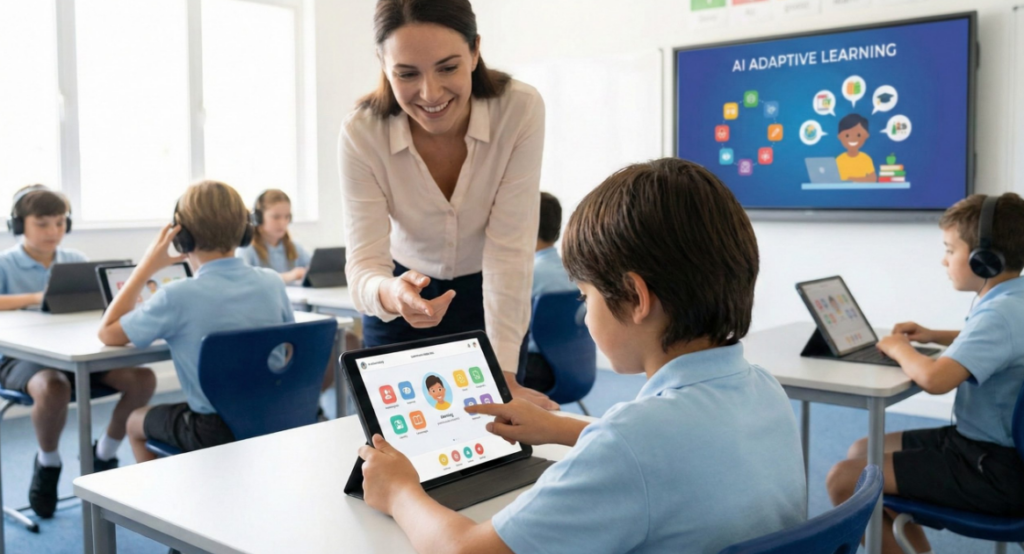
Adaptive learning platforms are changing the game for students like me. These systems use machine learning to assess a student’s current knowledge level, identify gaps in understanding, and deliver customized content that meets their exact needs. If you struggle with fractions, the platform will give you extra practice problems, video tutorials, and interactive exercises until you master the concept. If you’re ahead of the curve, it will challenge you with more advanced material, so you never get bored.
What I love most about AI in education is how it frees up teachers to do what they do best: teach. By automating routine tasks like grading multiple-choice tests, tracking attendance, and generating lesson plans, AI gives teachers more time to build relationships with their students, facilitate discussions, and provide one-on-one support. I’ve talked to several teachers who say that since they started using AI tools, they’ve been able to connect with their students on a deeper level and actually enjoy teaching again.
AI is also making learning more engaging and immersive. Virtual reality (VR) and augmented reality (AR) technologies, powered by AI, allow students to explore historical sites, conduct virtual science experiments, and interact with complex concepts in ways that were previously impossible. Imagine being able to walk through ancient Rome, dissect a virtual frog, or manipulate 3D models of molecules – all from your classroom. That’s the kind of learning that sticks with you.
Of course, there are challenges. Not all students have access to the technology and internet connectivity they need to use these tools, which could widen the achievement gap between privileged and disadvantaged students. And there’s always the risk that over-reliance on technology could lead to a loss of basic skills like handwriting and mental math. But I believe these are solvable problems. With the right investments and policies, we can ensure that every student has access to the benefits of AI-powered education.
At the end of the day, education should be about helping each student reach their full potential. For too long, we’ve forced students to fit into a one-size-fits-all system that doesn’t work for everyone. AI is finally giving us the tools to create a more personalized, equitable, and effective education system – one where every student can succeed, regardless of their background or learning style.